
Overview Why the Rules Are So Different
Bar rules 8-ball has no single official governing document. It is a collection of conventions that evolved in taverns and pool halls over decades, varying somewhat from location to location. The Cornerman Billiards bar rules referenced here, compiled by Freddie Agnir, is one written summary of those conventions.
APA 8-ball, by contrast, is a fully codified ruleset published in the APA Official Team Manual. It is designed for handicapped league competition, and several of its rules, particularly around shot calling, ball-in-hand, safeties, and coaching, reflect that competitive, handicapped context rather than a casual game between strangers at a coin-op table.
- Governed by the APA Official Team Manual
- Handicapped league format (The Equalizer® system)
- Slop counts, no shot calling required
- Ball-in-hand anywhere on table for most fouls
- Safeties are legal and explicitly recognized
- Must mark 8-ball pocket with a physical marker
- Coaching allowed via time-out system
- Soft breaks prohibited
- No single governing document; varies by location
- Casual format, no handicap system
- Call all the details: every combo, kiss, and cushion
- Ball-in-hand in the kitchen only, and only on a scratch
- Safeties not permitted, honest effort required
- Call the pocket verbally; no physical marker required
- No coaching structure
- Break just has to hit the rack
Full Comparison Rule by Rule
The table below compares each major rule area. Rows marked Same are functionally identical or nearly so between the two formats. Rows marked Different are areas where the formats diverge, sometimes significantly.
| Rule Area | APA 8-Ball | Bar Rules 8-Ball |
|---|---|---|
| Shot Calling Different |
Slop counts. The shooter does not need to designate the intended ball or pocket, except when legally shooting the 8-ball. | Call all the details. Every intended combo, kiss, carom, rail-first hit, kick, and bank must be called. Failure to call loses the turn; the cue ball stays. |
| Legal Break: Requirements Different |
Cue ball must be behind the head string. The head ball or second row of balls must be struck first. At least four object balls must be driven to the rails, or one object ball must be pocketed. Soft or safe breaks are prohibited. | Cue ball must be behind the head string. The breaker must hit the rack. No requirement for how many balls reach a rail and no specific ball must be struck first. No soft break rule is specified. |
| Failed Legal Break Different |
If the rack is struck but the break does not qualify as legal (e.g., fewer than four balls to the rail and none pocketed), the same player rebreaks. If it also results in a scratch, the other player rebreaks. | If the breaker fails to hit the rack entirely, they try again. No provision for a failed-but-struck break is specified, as the bar rules break has no minimum rail or pocket requirement. |
| 8-Ball Pocketed on the Break Same |
Win, unless the player also fouls the cue ball (scratch or cue ball off the table), in which case it is a loss. | Win, unless the cue ball also scratches or leaves the table on the same stroke, in which case it is a loss. |
| Scratch on the Break Same |
Ball-in-hand behind the head string. The incoming player must shoot at a ball outside the head string. | Ball-in-hand in the kitchen (behind the head string). The incoming player must shoot out of the kitchen. |
| Group Selection: Open Table Same |
The first ball legally pocketed determines the shooter's group. If balls from both groups are pocketed on the break, the table remains open. If only one group is pocketed on the break, that group belongs to the breaker. | Take what you make: making a ball on the break determines that set. If at least one ball of each group is pocketed on the break, the table remains open. |
| Ball-in-Hand After a Foul Different |
Most fouls result in ball-in-hand anywhere on the table. The incoming player may place the cue ball anywhere on the playing surface. | Only a cue ball scratch gives ball-in-hand, and only in the kitchen. Other fouls (wrong ball, failure to drive a ball to a rail) result in loss of turn only, with no ball-in-hand penalty. |
| Foul: Wrong Ball First Different |
Ball-in-hand foul. The opponent may place the cue ball anywhere on the table. | Loss of turn only. The cue ball remains where it stopped. No ball-in-hand is awarded to the opponent. |
| Foul: No Rail After Contact Different |
Ball-in-hand foul. After the cue ball contacts the object ball, a rail must be struck by either ball, or a ball must be pocketed. | Not enforced as a ball-in-hand foul. Loss of turn is the only stated penalty for most non-scratch fouls. |
| Frozen Ball Rule Different |
Detailed rule. After contacting a ball frozen to a rail, the shooter must drive the cue ball to any rail, drive the frozen ball to another rail or pocket, or drive it into another ball causing a rail contact or pocket. Failure is a ball-in-hand foul. | Not addressed as a specific enforced rule in bar rules reference material. Standard bar play does not formally enforce the frozen ball obligation. |
| Safeties / Defensive Play Different |
Safeties are legal and explicitly recognized as an ethical defensive shot. Players are expected to declare their safety. Scorekeepers mark it as a Defensive Shot on the scoresheet. | Bar rules are an honest-effort-to-pocket-a-ball game. Obvious safeties are not permitted. A player with no available shot may say so and is expected to play a shot that opens balls up, not a deliberate hook. |
| Jump Shots Same |
Legal using a regular shooting cue. Dedicated jump cues are permitted only in the Masters Division. Intentionally scooping the cue ball over another ball is a ball-in-hand foul. (See your local league by-laws and pool room specific rules regarding jump-shots) | Legal, provided the shot is executed with a legal stroke. Scooping or intentionally miscuing to jump is not permitted. |
| Object Balls Jumped Off the Table Different |
Not a foul. The ball is spotted on the foot spot when the shooter's turn ends. If the 8-ball is knocked off the table, the shooter loses the game. | A foul and loss of turn. The ball is spotted near the foot spot. If the 8-ball is jumped off the table at any time, it is loss of game. |
| 8-Ball: Marking the Pocket Different |
A physical marker (coaster or similar object) must be placed next to the intended pocket before the shot. Failure to mark the pocket, if called by the opponent, is a loss of game. | The pocket must be called. No requirement for a physical marker is specified. The shot must conform with the called intention. |
| Combination Shots Using the 8-Ball Different |
The 8-ball may not be contacted first and is never neutral. A player may not use the 8-ball as the first ball in a combination shot. If a player's ball is pocketed but the 8-ball was contacted first, the player loses their turn. | The 8-ball cannot be used in a combination at any point, not as the first ball and not in the middle of a combination. Using the 8-ball in a combination results in loss of turn. |
| Scratch While Shooting the 8-Ball Same |
Loss of game, even if the 8-ball is not pocketed (a "table scratch" where the shooter misses the 8-ball entirely gives ball-in-hand, not a loss; but a cue ball scratch while the 8-ball is the legal object ball is a loss). | Loss of game if the cue ball scratches or leaves the table when playing the 8-ball, whether or not the 8-ball is also pocketed. |
| Pocketing the 8-Ball and Last Ball Together Same |
Loss of game. The 8-ball must be pocketed through a separate shot after all other balls in the shooter's group are cleared. | Loss of game. The last object ball and the 8-ball may not go in on the same stroke. |
| Coaching Different |
Allowed. A time-out must be called before coaching begins. A designated coach may advise the shooter during their turn. The number of time-outs per game varies by skill level (SL1–3 get two; SL4 and above get one). Receiving advice from a non-designated player during a time-out is a ball-in-hand foul. | No coaching structure exists in bar rules. Bar rules 8-ball is played as an individual game with no formal time-out or coaching mechanism. |
Detail Shot Calling: The Biggest Practical Difference

The biggest rule shift between bar pool and APA league play is shot calling. Bar rules are a "call all the details" game: every intended combination, carom, kiss, rail-first hit, and kick must be called before the shot. If the ball goes in a way that was not called, the shooter loses their turn, even if the ball drops in the intended pocket. The exception is incidental contact between the object ball and the cushions adjacent to the called pocket on its final approach, which does not need to be called.
APA 8-ball, by contrast, does not require any shot calling. Slop counts. The shooter has no obligation to name the ball or the pocket except in one situation: when legally shooting the 8-ball, the intended pocket must be marked with a physical marker before the shot is taken.
Detail The Break
APA's break requirements are more specific than bar rules in two ways. First, the cue ball must make contact with either the head ball or the second row of balls. Striking a different part of the rack is not technically a foul, but the break does not count as legal and the same player must rebreak, with one important exception: if an illegal break also results in a scratch, the opposite player takes the rebreak. Second, the break must be hard: at least four object balls must reach the rails, or one must be pocketed. A soft break results in a rebreak by the same player, and consistent soft breaking may be penalized by Local League Management as a sportsmanship violation.
Bar rules have no minimum rail count and no specific ball the breaker is required to strike first. The breaker simply has to hit the rack. A complete miss of the rack results in the player trying again.
Detail Fouls and Ball-in-Hand
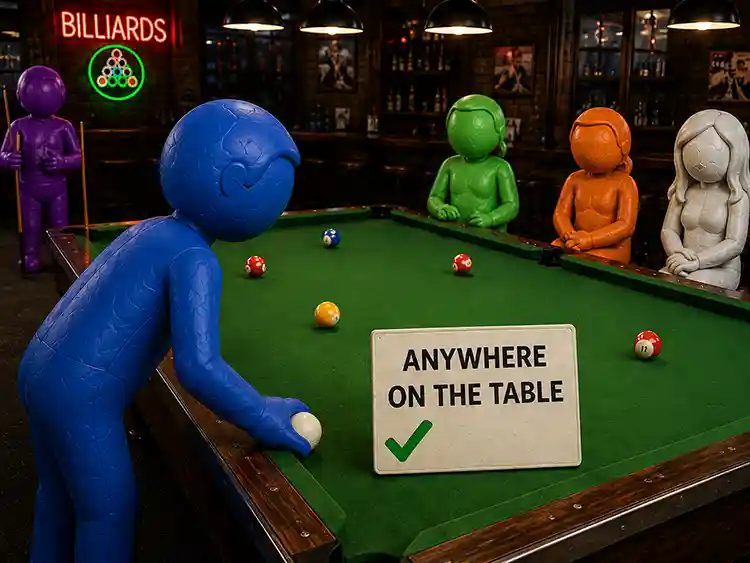
This is the area of greatest structural difference between the two formats. In APA, there is a defined list of fouls that each result in ball-in-hand anywhere on the table. Those fouls include: the cue ball going off the table, failure to hit the correct ball first, failure to drive any ball to a rail or into a pocket after contact, intentionally scooping the cue ball, double-hitting the cue ball, and touching the cue ball outside a ball-in-hand situation. The incoming player may place the cue ball anywhere on the playing surface.
Bar rules recognize far fewer fouls and impose a much lighter penalty for most of them. The only foul that gives ball-in-hand in bar rules is a cue ball scratch, and even then, ball-in-hand is restricted to the kitchen. Hitting the wrong ball, failing to drive a ball to a rail, or committing most other technical violations results only in loss of turn, with the cue ball staying where it stopped and no ball-in-hand awarded to the opponent.
Detail Safeties and Defensive Play
In APA, a safety is a fully legal and explicitly recognized shot. The APA rulebook defines it as "a defensive action taken when the shooter has no makeable or high percentage shot, or chooses to leave their opponent in a difficult situation." Players are expected to declare their safety, and scorekeepers mark it as a Defensive Shot on the scoresheet. Failing to mark defensive shots correctly can affect a player's handicap calculation.
Bar rules treat pool as what the Cornerman reference calls an "honest effort" game. A player must make a genuine attempt to pocket a ball on every shot. Obvious safeties, deliberate hooks with no attempt at a ball, are not allowed, and the bar rules reference notes they are grounds for being removed from the game. The one recognized exception is when no shot is available at all: in that case, a player may acknowledge it and play a shot that opens the table.
Detail Playing the 8-Ball
Both formats agree on the basics: pocket all balls in your group, then legally pocket the 8-ball. Several of the surrounding rules differ, however.
In APA, the 8-ball must be pocketed in a pocket that was marked with a physical coaster or similar object before the shot. If the ball drops and the pocket was not marked, and the opponent calls loss of game, the shooter loses. In bar rules, the pocket must be called verbally, but no physical marker is required.
On combination shots, APA prohibits the 8-ball from being contacted first; it is never neutral. Bar rules go further: the 8-ball cannot appear anywhere in a combination, not just as the first ball. Using the 8-ball in the middle of a combination under bar rules is loss of turn.
Both formats agree that pocketing the last ball of your group and the 8-ball on the same stroke is a loss of game. Both formats also agree that scratching while the 8-ball is the legal object ball is a loss of game.
FAQ Common Questions
If I learned to play at a bar, what's the most important rule to remember in APA?
You no longer need to call your shots; slop counts in APA. The one exception is the 8-ball, which must be pocketed in a marked pocket. Also be prepared for ball-in-hand anywhere on the table after a foul, not just ball-in-hand in the kitchen.
If I play APA league, what's the most important rule to remember in a bar game?
You must call all the details on every shot: the ball, the pocket, and every intended cushion, combination, or kiss. Playing slop and picking up ball-in-hand anywhere are both specific to league play. In a bar game, most fouls result only in loss of turn, not ball-in-hand.
Can I play a safety in an APA league match?
Yes. Safeties are legal in APA and must be declared by the shooter and marked as a Defensive Shot on the scoresheet by the scorekeeper. They are a recognized part of competitive strategy.
Do I get coaching in APA that I wouldn't get in a bar game?
Yes. APA allows a designated coach to advise you during your turn at the table, provided a time-out has been called first. SL1–3 players and unrated new players receive two time-outs per game; SL4 and above receive one. Bar rules have no equivalent coaching or time-out structure.
What happens if an object ball is jumped off the table in APA vs bar rules?
In APA, jumping an object ball off the table is not a foul; the ball is simply spotted on the foot spot when the shooter's turn ends. In bar rules, it is a foul and loss of turn, with the ball spotted near the foot spot. In both formats, jumping the 8-ball off the table at any time is a loss of game.
Dr. Dave Alciatore has a video on bar rules:
He covers differences from official rules, common bar rule variations, and shots considered "dirty pool" in casual play.
Dr. Dave notes that house rules vary significantly by location and recommends confirming the specific rules before play. He also suggests agreeing to use the official WPA rules as a shared reference when house rules are unclear.
Playing in an APA league? LineupMagic.com calculates every valid lineup for your team, sorting by strongest combinations first, automatically applying the 23-Rule skill cap, and flagging senior skill level concerns if your league uses that rule.
Try It Free Tonight
The rule comparisons on this page are my interpretation of publicly documented APA League rules and widely cited bar rules conventions, and are intended as a general reference only, not legal or official league guidance. APA rules are drawn from the APA Official Team Manual (League Years '26/27, '27/28 & '28/29). Bar rules are based in part on the Cornerman Billiards written reference and general bar pool conventions, which vary by location. Always confirm the specific house rules at your establishment before play.
Lineup Magic is an independent tool and is not affiliated with, authorized by, or endorsed by the American Poolplayers Association (APA) or any pool league organization.